The Role of Rhythmic Activity in the Development of Auditory Processing and Response Inhibition
Authors: Finnilä, Elena; Kujala, Jan; Parviainen, Tiina
Department of Psychology, Centre for Interdisciplinary Brain Research (CIBR)
University of Jyväskylä, Jyväskylä, Finland

Hi!
I am happy to see you here! 

I’m Elena, a psychologist and doctoral researcher interested in brain plasticity, development, and the neural basis of inhibition. On this informal page, you can take a closer look at the results of our study and explore some of the findings in more detail.
 I’d be glad to connect with you!
Below you’ll find more detailed figures illustrating the results of our study.
The passive listening task
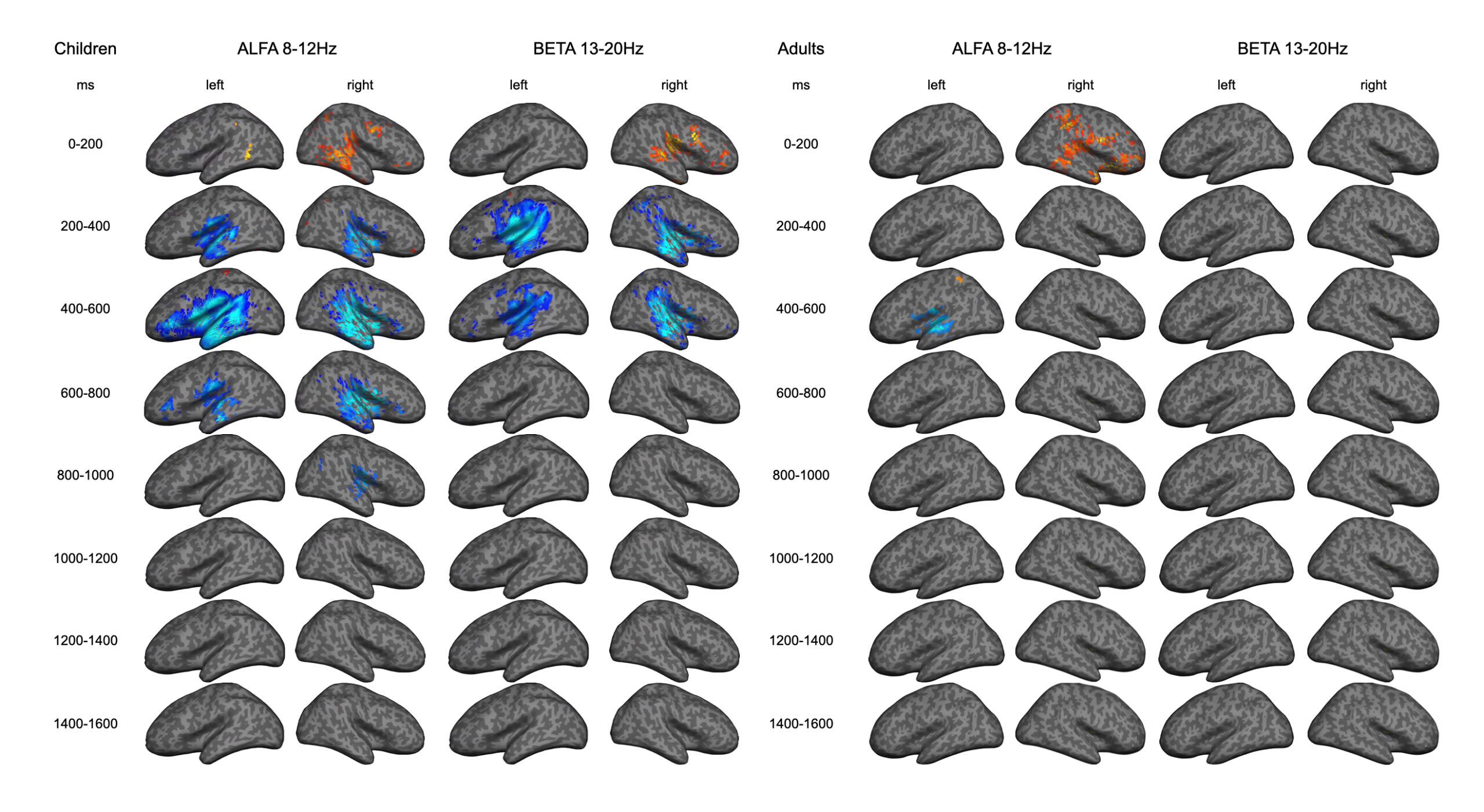
- Children exhibited increased modulation of oscillatory power (colors of red and yellow) in both alpha- and beta-bands in the right hemisphere 0–200 ms after stimulus onset. This was followed by bilateral alpha power suppression (200–1000 ms, blue color) and beta power suppression (200–600 ms).
- Adults had alpha power increase in the right hemisphere during 0-200 ms followed by alpha power suppression during 400-600 ms in the left hemisphere.
- There were no significant differences in passive listening task between children and adults.
The passive listening task in children
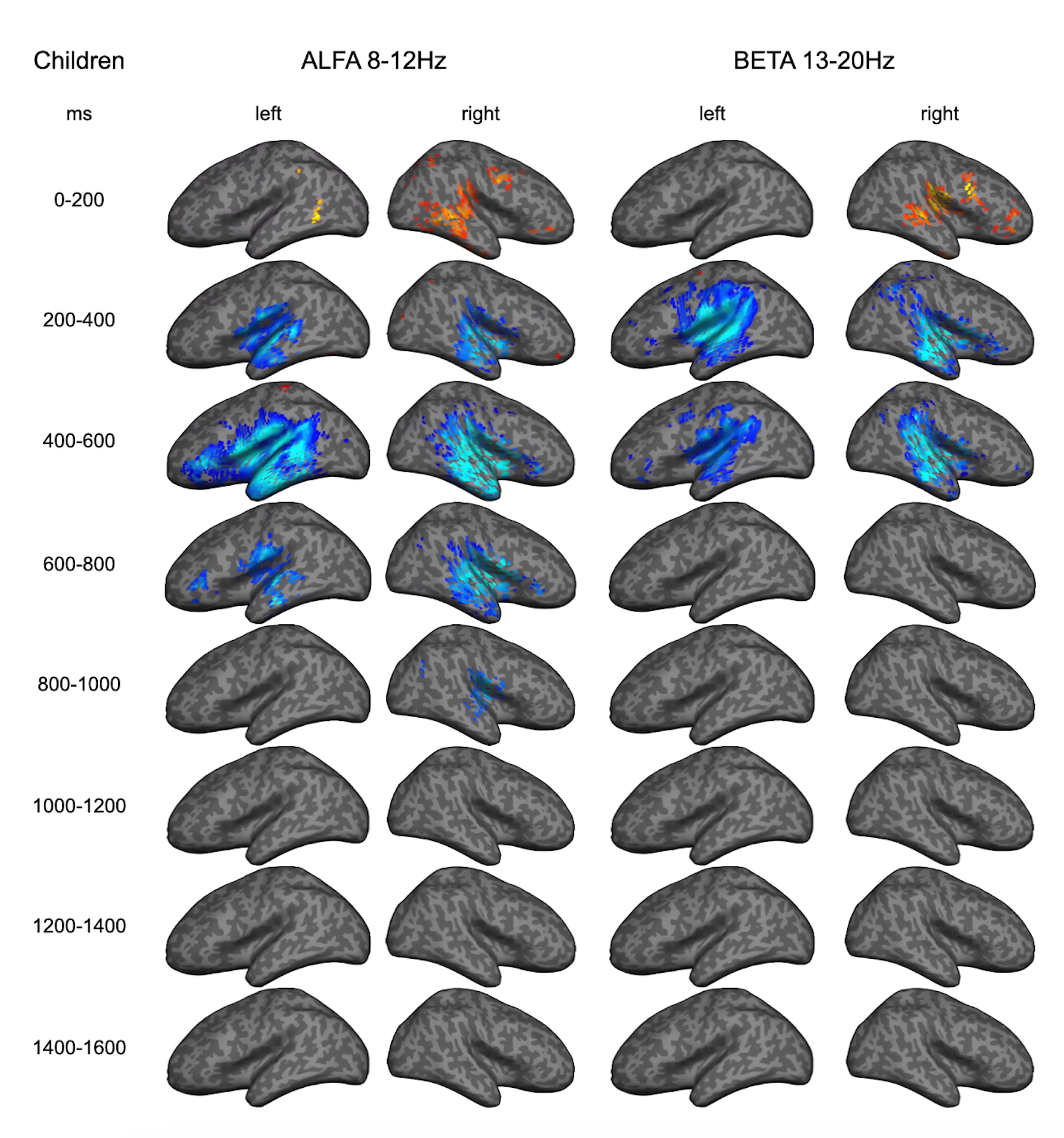
- Children exhibited increased modulation of oscillatory power (colors of red and yellow) in both alpha- and beta-bands in the right hemisphere 0–200 ms after stimulus onset.
- This was followed by bilateral alpha power suppression (200–1000 ms, blue color) and beta power suppression (200–600 ms).
The passive listening task in adults
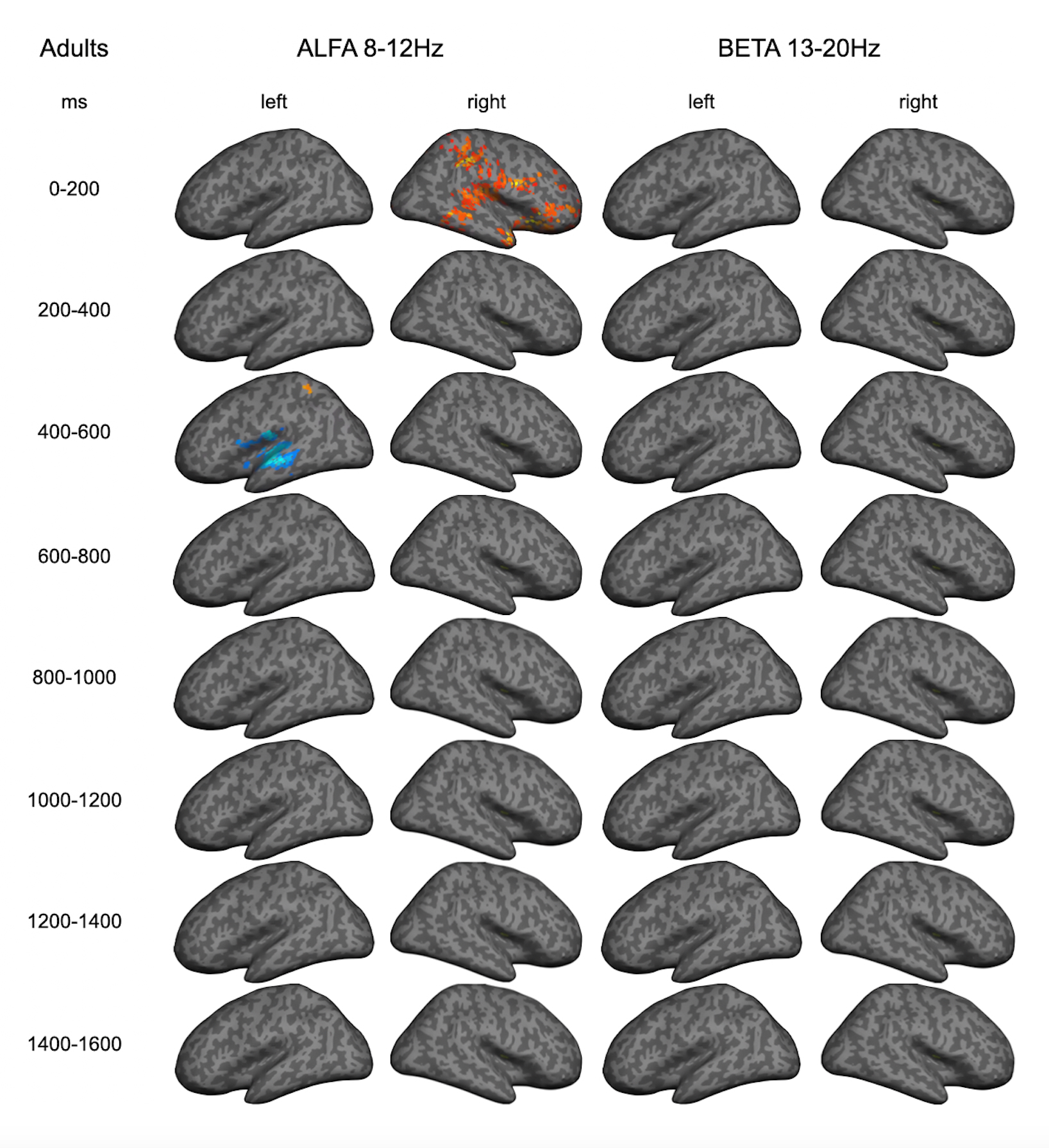
- Adults exhibited alpha power increase in the right hemisphere during 0-200 ms followed by alpha power suppression during 400-600 ms in the left hemisphere.
- There were no significant differences in passive listening task between children and adults.
The Go/Nogo task
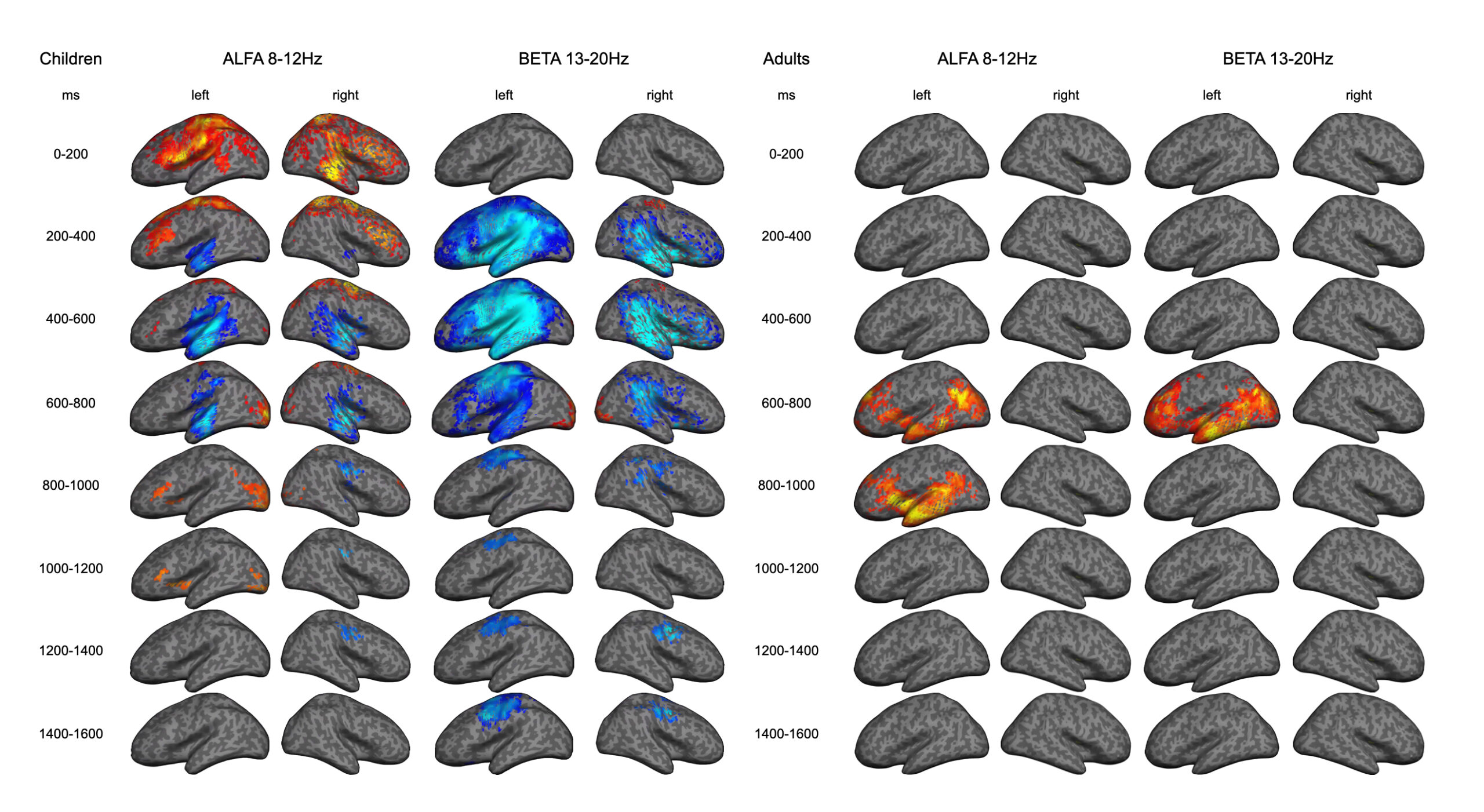
- In adults, significant alpha power increase was observed between 600–1000 ms and beta power increase between 600–800 ms, distributed across temporal, frontal, posterior parietal, and occipital regions.
- In children, significant bilateral alpha power increase was observed during 0–600 ms in somatomotor, posterior parietal, and prefrontal cortical regions. This was followed by bilateral alpha power suppression from 200–800 ms in temporal regions.
- In children, beta power showed strong, widespread bilateral suppression during 200–800 ms, which continued in the somatomotor areas until 1600 ms.
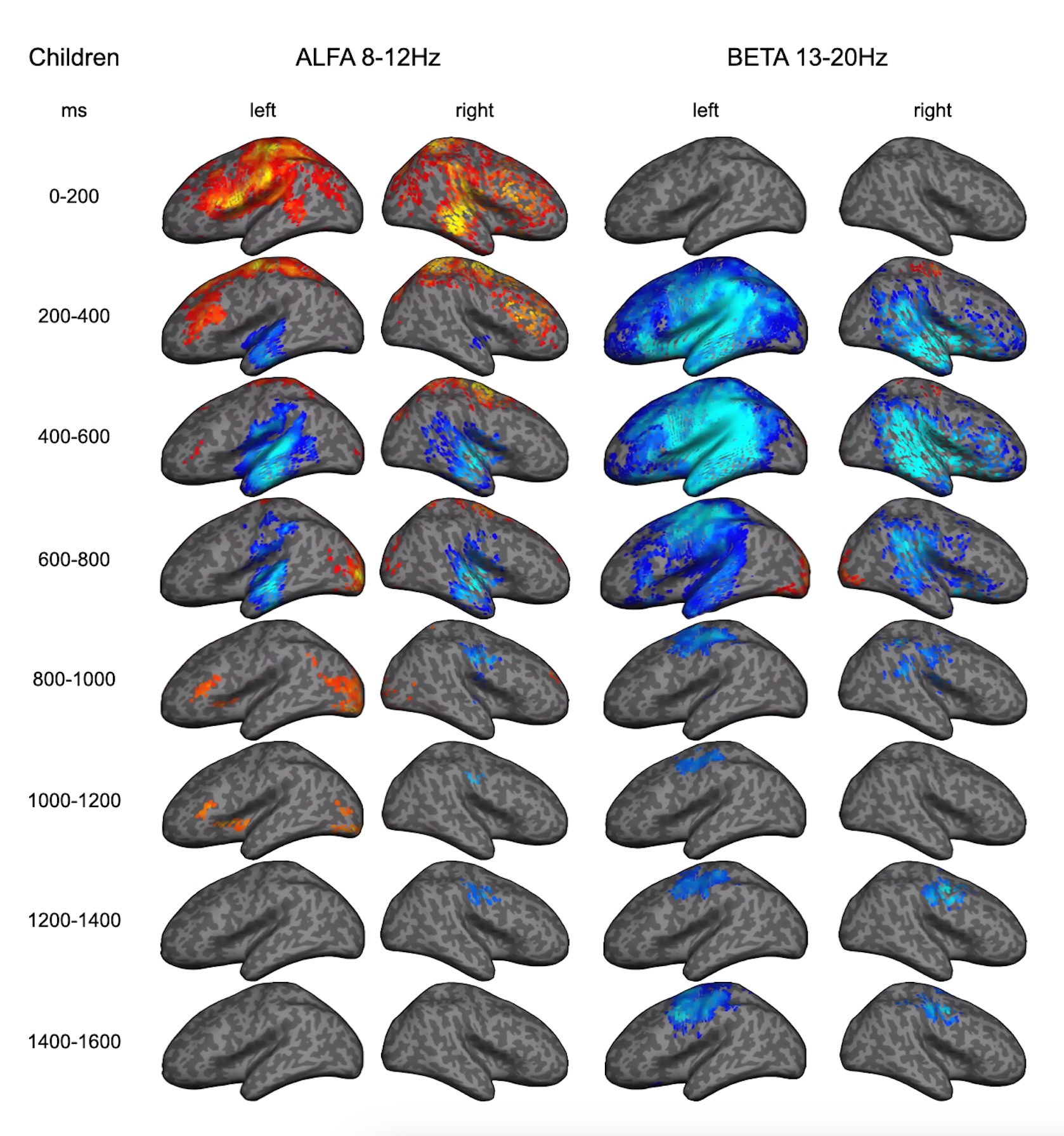
Go/Nogo task in children
- Significant bilateral alpha power increase was observed during 0–600 ms in somatomotor, posterior parietal, and prefrontal cortical regions.
- Bilateral alpha power suppression from 200–800 ms in temporal regions.
- Beta power showed strong, widespread bilateral suppression during 200–800 ms, which continued in the somatomotor areas until 1600 ms.
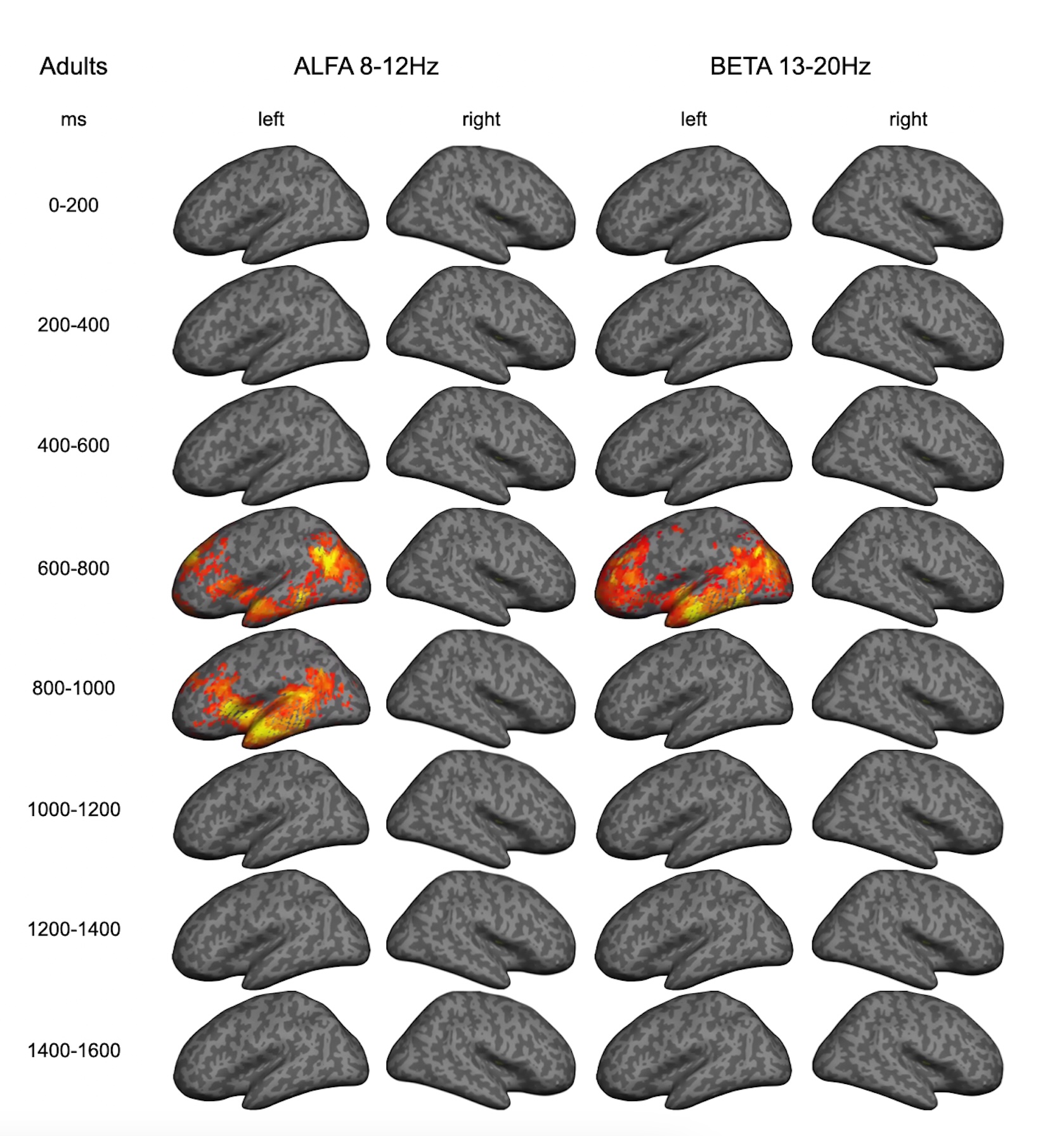
Go/Nogo task in adults
- Significant alpha power increase was observed between 600–1000 ms and beta power increase between 600–800 ms, distributed across temporal, frontal, posterior parietal, and occipital regions.
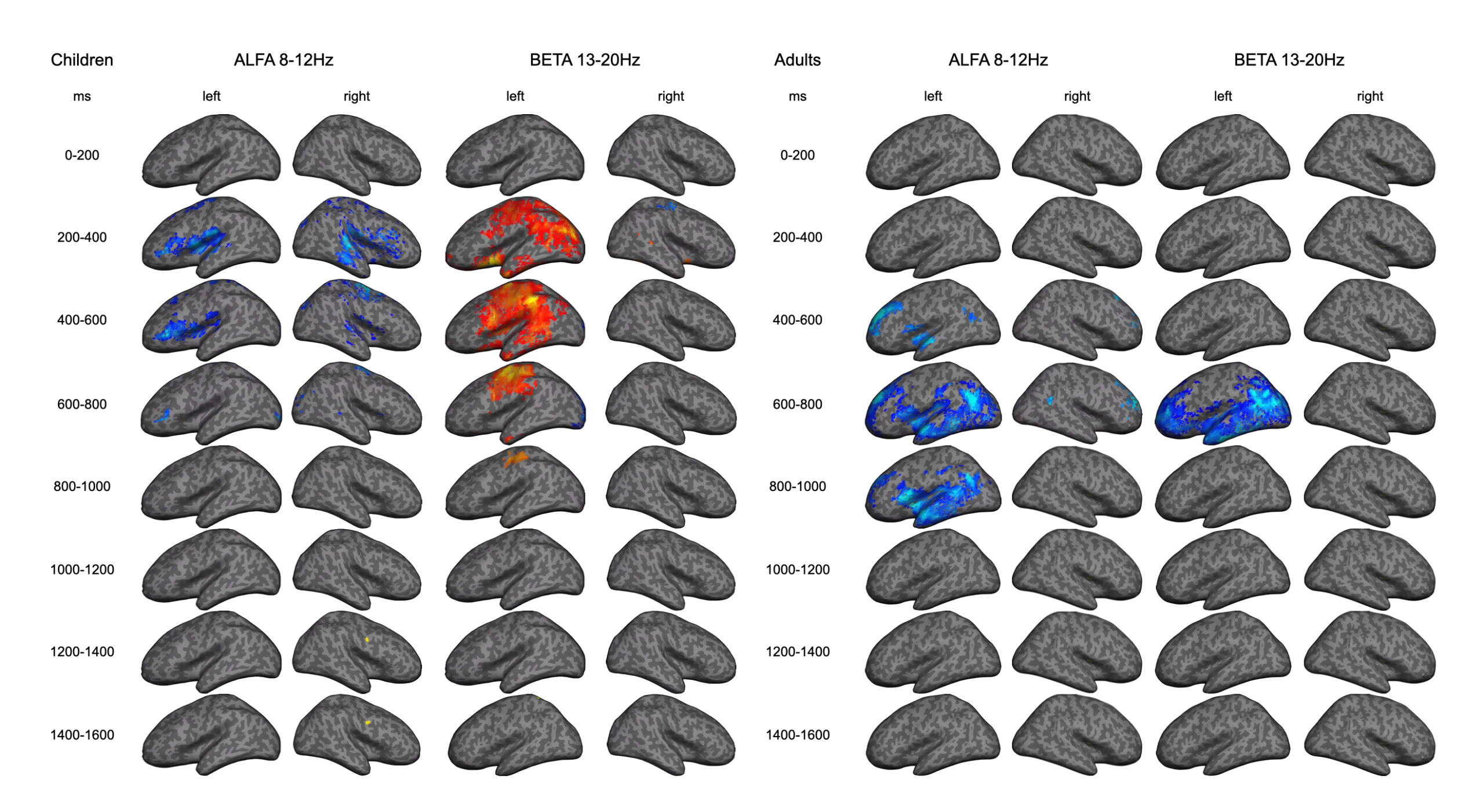
Passive listening vs Go/Nogo
Differences in rhythmic brain activity between the passive listening and Go/Nogo tasks in alpha and beta power in children and adults.
- In adults, differences in alpha power were observed from 400–1000 ms, particularly over the left posterior parietal, lateral temporal, and occipital cortices. Differences in beta power were found between 600–800 ms in the left posterior parietal and lateral temporal regions.
- In children, differences in alpha power were observed bilaterally from 200–800 ms, involving somatomotor, posterior parietal, and prefrontal cortices. Differences in beta power occurred between 200–1000 ms in the left posterior parietal, lateral temporal, and somatomotor regions, and between 200–400 ms in the right temporo-parietal cortex.
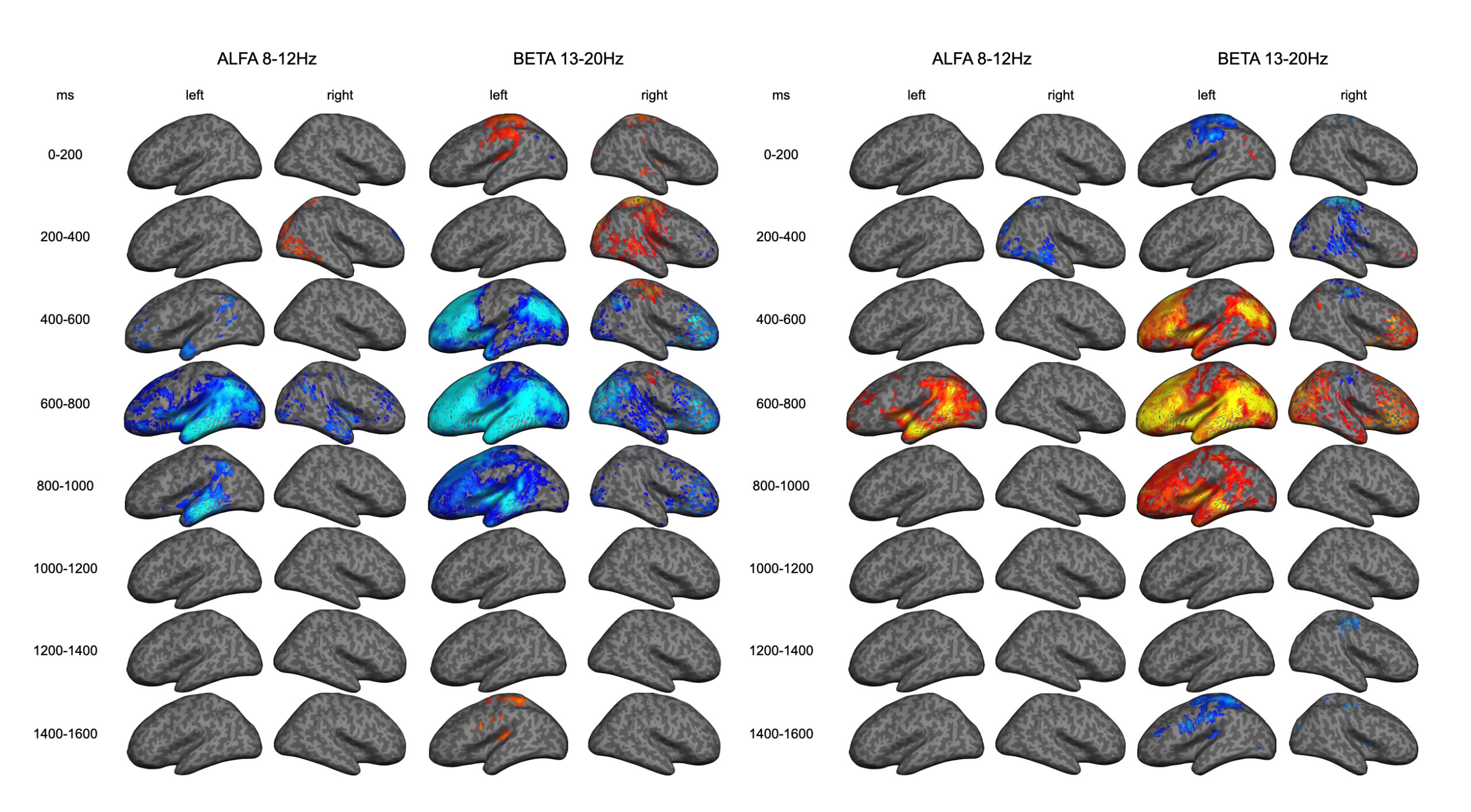
Left picture: Age-related differences during the Go/Nogo task (There were no significant differences in the passive task.)
- In alpha power, differences were observed between 200 and 400 ms in the right occipital cortex and from 400 to 1000 ms in bilateral temporal and occipital cortices, as well as in posterior parietal, inferior frontal and dorsolateral regions.
- In beta power, differences were present from 0 to 1000 ms, first involving somatomotor and occipital cortices (0–400 ms), and later extending across frontal, temporal, parietal, and occipital cortices (400–1000 ms). Additional differences in beta power were also observed in somatomotor regions between 1400 and 1600 ms.
Right picture: Differences between children and adults for the passive listening vs. Go/Nogo task contrast.
- In alpha power, differences appeared between 200 and 400 ms in the right posterior parietal and lateral temporal cortices, and between 600 and 800 ms bilaterally in occipital, posterior parietal, and frontal cortices.
- In beta power, differences were observed from 0 to 1000 ms across somatomotor, posterior parietal, lateral temporal, and occipital cortices, and from 1200 to 1600 ms mainly in somatomotor and posterior parietal cortices.
Department of Psychology, Centre for Interdisciplinary Brain Research (CIBR), University of Jyväskylä, Jyväskylä, Finland
Have a question or some feedback? I am happy to hear from you! :)